Molly's story: "I thought ADHD meant bouncing off the walls."
Written by Molly, Oct 27, 2026
Molly works as a freelance journalist, juggling multiple contracts at a time, after years in theatre and retail. She was diagnosed with ADHD at 37.
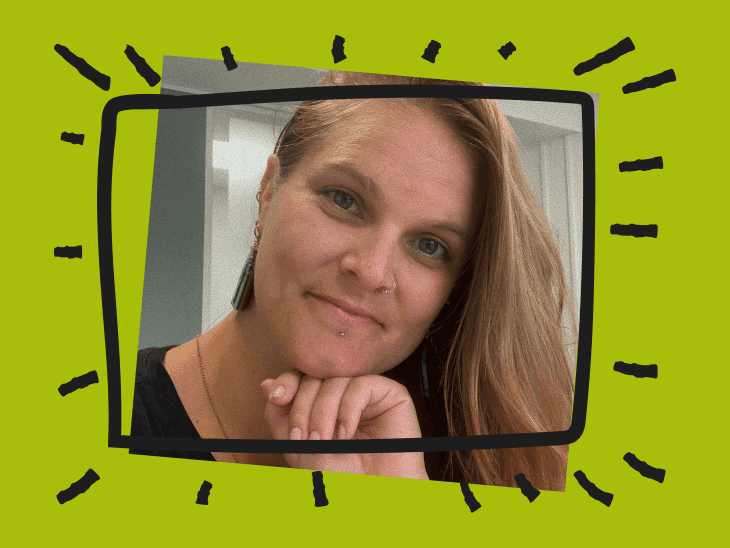
The world has never quite made sense to me, not since I was a kid. It always felt a bit spiky. I just thought I was strange, because that's what I was told. Children can be mean like that.
When you think ‘ADHD’, you think naughty little boys bouncing off the walls. I'm introverted. I don't like standing up in front of people. So, I didn't recognise some of the traits in myself. Not before I realised ADHD presents so differently in women.
I didn't think it could be me
One of my female friends got an ADHD diagnosis, and she was incredibly open about how much it had helped her professionally. Then a couple more of my female friends got late diagnoses too.
I still wasn't sure about myself, but I'd started to really struggle at work. Crying at spreadsheets and frustrated that I couldn't do things the same way everyone else did. That was the point I thought, “let's give this assessment a go.”
The form was harder than the diagnosis
The hardest part of the whole process wasn't the assessment. It was the pre-assessment questionnaire. I remember thinking, “is this part of the test? If I can finish this in time, does that mean I don't have ADHD?”.
During the assessment, I kept thinking I was answering in a way that wouldn't get me a diagnosis. My assessor asked whether I’d struggled at school. “Not really, I taught myself to sit still.”
Then she asked whether I ever wanted to get up and leave during a long meeting. “Of course I do”, I said, “doesn't everyone? I just don't, because I've learned manners.”
My assessor stopped me there. "Don't answer with what you've learned to do – what is your body actually telling you?”. And I realised, sitting still that long is physically painful. It makes me angry. That's when I nearly burst into tears. ADHD was the reason for all of it.
I chose not to medicate, and that's alright too
I've been on medication before, for other things, and I know from experience it's not right for me at the moment. I want to get to know who I am first. The highs and the lows.
Not being on medication doesn't mean the diagnosis hasn't changed things for me. I can recognise my own patterns now. If I've had a huge, productive day, I know a crash is probably coming, so I try to be kind to myself about the day after. I've started putting boundaries in place. For years I tried to fit into everyone else's timetable and just kept crashing. I don't have to do that anymore. I know why my brain works differently now.
There’s been a grieving process for my younger self
Like a lot of women who get diagnosed late, there's been a grieving process for my younger self. I remember being down at the bottom of the garden for hours as a kid, playing in mud, pretending a box was a spaceship. I was so content. But teenage-me felt trapped in a way little-me never did. Now I understand why I behaved that way, why I felt the things I felt.
As an adult, I’ve spent years playing a version of myself I used to think was just who I was. Loud, performing and always "on". I thought that was the only way to make friends or keep a job. But now I've found a small group of women, all diagnosed late like me, who I never have to perform for.